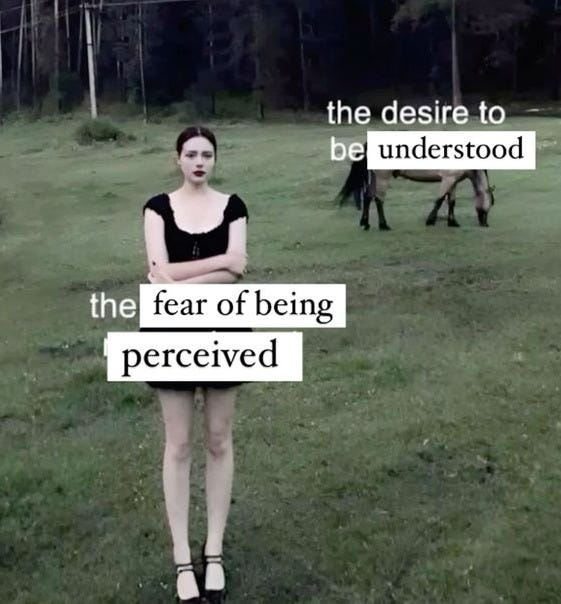

I genuinely hate being perceived.
And while it might sound like the most unserious, serious thing I’ve ever confessed, I’m not joking. I am hereby officially declaring: I no longer want to be perceived. Ever. The thought of it—the idea that people are out there forming their own, unregulated thoughts about me—is enough to make my skin crawl.
The version of myself I’ve so painstakingly sculpted in my mind? That’s not the version sitting in the brains of everyone who’s met me, heard of me, or even just scrolled past me on social media. And I hate that.
The fact that someone might speak about me when I’m not there, conjuring some version of “me” that I have no control over—it’s suffocating. It’s a reminder of how fragmented identity really is. Who we think we are, who others think we are, and who we actually are? They rarely, if ever, align. Every time I consider this, I’m thrown into a spiral. Why can’t we all just exist as these elusive, ephemeral concepts—living, but not quite there? Free of the burden of being perceived, categorised, and misunderstood.
Let me pitch this idea: what if we were all allowed to become nothing but voids in the minds of others? Think of my name, and there’s nothing there but blank space. A gentle whisper of an idea that never fully forms. We wouldn’t have to overthink our actions or cringe at the memory of something we said three years ago. There would be no fear of being misrepresented, misinterpreted, or worse, completely forgotten for the wrong reasons.
But why does the idea of being perceived terrify me so much? It’s not just vanity or insecurity—it’s the fundamental human need for control. I want to control how I’m remembered, how I’m understood, and how I live on in the minds of others. And yet, it’s impossible. We are mirrors in a hall of distorted reflections. Everyone we meet sees us through their own cracked lens of experience, biases, and emotions. Who I am to me is only one version of a character playing a thousand roles in other people’s narratives. I think about how we’ve tied so much of our self-worth to this perception game. Social media only makes it worse. It feeds into this hyper-awareness that our every word, post, and image is another piece of clay for others to mould into their version of us. It’s exhausting. And maybe that’s why I crave invisibility so desperately. Not literal invisibility, but the freedom to just be, without the weight of other people’s perceptions pressing down on me.
But then, I realise, there’s a paradox here. If no one perceived me, would I even exist in any meaningful way? Aren’t we shaped, at least in part, by the connections we make and the impact we have on others? Maybe the answer isn’t to vanish from people’s minds but to accept that being perceived is as much a part of being human as breathing.
Though, even when I try to rationalise the idea of being perceived, to intellectualise it and file it neatly into a box labelled "This is Just How Humans Work," I still find myself baffled. Because let’s be honest: perception is messy.
Have you ever had someone say something about you—something they claim is you—and you’re left staring at them in utter disbelief? That version of you they’ve cobbled together is so wrong, so utterly detached from who you believe yourself to be, that it shakes you.
For some people, maybe it’s not that deep. Maybe it’s just an annoyance, a fleeting moment of confusion. But for me, it’s earth-shattering. It’s not just about being misunderstood—it’s the ripple effect it causes. It makes me question everything: every decision I’ve made, every interaction I’ve had, every version of myself I’ve presented to the world.
Was I wrong about who I am? Am I the only one who sees me this way? Or worse, am I blind to the parts of myself that others see so clearly?
And then there are the times when the act of being perceived feels downright invasive. Like when someone you don’t even know already knows your name. Maybe they drop it casually in a conversation, and suddenly, you’re frozen, wondering: How? How do they know my name? What was said, and by whom, for it to reach their ears? Did someone bring me up in passing? Did they stumble across my social media and dissect it with friends, making quiet judgments or jokes at my expense? The possibilities stretch endlessly, each one more unsettling than the last.
This is the thing about being perceived—it’s not just about being seen; it’s about being constructed. People build versions of you in their minds, and you have no say in the blueprint they use. Maybe it’s based on a single interaction, a fleeting impression, or some exaggerated story passed along the grapevine. Or maybe it’s worse than that: maybe it’s their projections, their insecurities, and their biases layered onto you like coats of paint until the “you” they’ve created is unrecognisable.
And the thing is, there’s no escaping this. We’re all doing it, all the time. I know I do it, too. I see someone across the room, I hear a snippet of conversation, and my brain goes to work filling in the gaps, building a version of them that’s probably more fiction than fact. It’s human nature. But knowing that doesn’t make it easier to accept when I’m the one being rewritten.
I think what gets me the most is the helplessness of it all. I can’t climb into someone’s brain and fix their version of me. I can’t sit everyone down and explain, No, you’ve got it all wrong—this is who I really am. I just have to exist in this strange, fractured reality where my identity is both mine and not mine, where I am both the author of my story and a character in someone else’s. It’s disorienting, like living in a house of mirrors where every reflection shows a different face.
To contradict myself now—because what’s a philosophical ramble without a little self-contradiction—I must admit that I’m stuck somewhere in the middle. As much as I loathe the idea of being perceived, I equally crave to be understood. It’s the most human of paradoxes, isn’t it? To want to be seen but only in the exact way we wish to be seen. Desire and rejection, craving and repulsion—that’s where I am, wedged between these two conflicting states of being.
But there’s a difference between being perceived and being understood. Perception is shallow, almost automatic—a reflexive process that’s often more about the perceiver than the perceived. Understanding, though, is deliberate. It requires effort, empathy, and an ability to look beyond surface-level assumptions. And maybe that’s where the frustration lies: too often, we aren’t perceived correctly, and the understanding we seek feels unattainable because people aren’t always willing to look beyond their initial judgments.
Think about it: if someone has already decided you’re the villain in their story, there’s little you can do to rewrite that narrative. To them, you’re not a complex character with motivations, fears, and contradictions; you’re a flat archetype, cast in the role of antagonist. And how do you fight against that? You can explain yourself, bare your soul even, but if they’ve already made up their mind, understanding becomes impossible. Their perception of you is a mirror reflecting only their own grievances, not your truth.
I think what stings most is the powerlessness of it all. We want to be understood so badly, yet the act of understanding is not ours to control. It’s a gift someone else has to choose to give us. And often, they don’t. Maybe they don’t have the capacity, or maybe they just don’t care enough to try. Either way, it leaves you stuck in this limbo of wanting to be known and fearing the inevitability of being misunderstood.
But here’s where it gets tricky. Even the people who love us the most, who try to understand us, who want to understand us—they don’t always get it right. And maybe they never will. Maybe true understanding is a myth we tell ourselves to feel less alone. Because even when someone gets close—so close you think, Finally, someone sees me—there’s still that lingering space between what you feel inside and what they perceive. That unbridgeable gap where your innermost self resides, untouched and unseen.
So, what do we do with that? Do we retreat, hiding ourselves away from the risk of being misunderstood? Or do we lean into the vulnerability of being perceived, flawed and imperfect as that perception may be? I don’t have an answer, but I know this: as much as I hate being perceived, as much as it makes my skin crawl to think of people forming their own messy, incomplete ideas about me, the alternative—being invisible, being unknown—feels even worse.
Maybe the answer lies not in being perfectly understood but in being willing to exist in the grey space between perception and reality. To accept that no one will ever fully “get” us, just as we’ll never fully “get” anyone else. And maybe that’s okay. Maybe understanding isn’t a destination we reach but a journey we keep choosing to embark on, even when we know the map is incomplete.
In the end, I think we all just want to be seen—not as the people others expect us to be, but as the messy, contradictory, beautifully flawed beings we truly are. And if we’re lucky, we’ll find a few people willing to try.